Momentum Doesn't Come From Moving Faster
Tatiana Jordan
Introduce standards on a product team and someone will eventually ask, “Don't you trust us?” It might be a common way to prioritize, measure success, make decisions, or hand work off. I've always found that reaction interesting because it assumes the purpose of standards is control. Most of the time, it isn't. It's consistency.
Not because people aren't capable, but because they're trying to do great work together. The best standards don't replace expertise. They give people something shared to build from, so every team doesn't have to figure out the same things for themselves.
You notice the cost pretty quickly when that consistency isn't there. Every team develops its own way of prioritizing, its own definition of success, and its own approach to solving problems. None of those approaches are necessarily wrong. Individually, they may work really well. But when everyone is working from a different playbook, alignment itself becomes work. Teams spend an enormous amount of time figuring out how to work together before they can get to the problem they're actually there to solve.
That's why I've never agreed with the idea that standards inherently slow organizations down. In my experience, the absence of standards is often what slows them down. Consistency isn't about getting everyone to work exactly the same way. It's about having enough shared understanding that people can move in the same direction without renegotiating how they're going to get there every time.
The fastest teams I've worked with didn't necessarily make fewer decisions. They just stopped making the same ones over and over. Without that shared foundation, every project eventually starts running into familiar questions. Didn't we already solve this? Which pattern should we use? Why are we approaching it differently this time?
I've watched incredibly talented teams spend more time recreating decisions than solving customer problems. The teams that moved fastest weren't necessarily the smartest teams in the room. They had shared context. They had principles they understood, language they used consistently, patterns they could rely on, and enough understanding of previous decisions to know when to reuse one and when there was a good reason to challenge it. A decision didn't disappear when a project ended. It became something the organization could build on.
That's what clarity looks like to me. Not more documentation or more process, but enough shared context that each decision can build on the ones that came before it.
And that's where I think AI becomes much more interesting.
I've been building with AI quite a bit, and one thing it has reinforced for me is that AI isn't impressed by experience. You can't tell it you've been doing this for twenty years and expect that to mean anything. You have to explain how you think. You have to make the reasoning visible: the principles, assumptions, tradeoffs, context, and judgment behind the answer.
That has made me realize how much important organizational knowledge has traditionally lived in people's heads. An experienced designer knows why a certain pattern exists. A product leader remembers why a particular decision was made three years ago. Someone who has been with the company long enough knows which constraint is real and which one is simply something everyone stopped questioning. We call that experience, but a lot of it is accumulated context and judgment that we've never had a particularly good way to capture or reuse.
This is where I think AI has much more potential than simply generating artifacts faster. If we can make good thinking explicit, AI gives us a way to make that thinking available at a scale and speed we haven't had before. A team shouldn't have to start from zero every time if the organization has already learned something useful.
Execution is getting cheaper. Producing screens, decks, variations, and even working software can happen faster than ever. That makes the work upstream more important, not less: understanding the right problem, reducing complexity, making tradeoffs, building shared systems, and giving people enough context to trust the next decision.
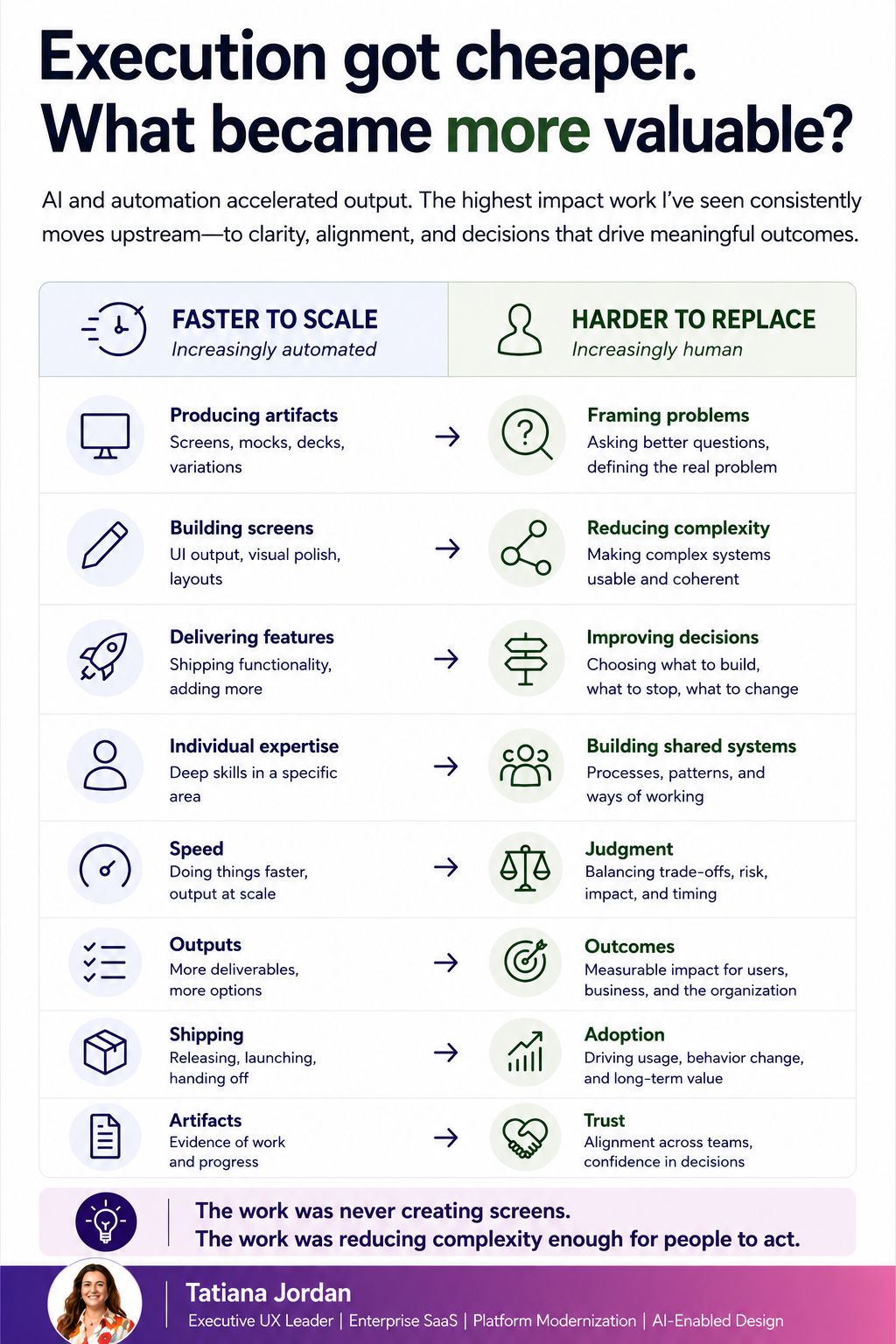
But there's an important catch. AI can only build from the foundation we give it. If our principles are unclear, our decisions are inconsistent, or we haven't done the work to understand why we're making the choices we're making, AI doesn't fix that. It just gives us the ability to reproduce the inconsistency faster.
I don't think the organizations that get the most value from AI will necessarily be the ones using the most AI tools. I think they'll be the ones that have done the harder work of making their principles, context, and judgment explicit enough that both people and AI can actually use them.
Which brings me back to momentum.
Over the last twenty years, I've worked on large enterprise platforms, organizational transformations, design systems, new products, and now increasingly AI-enabled ways of working. Across all of them, I keep seeing the same pattern. When something stalls, it's rarely because the people involved aren't talented or aren't working hard enough. More often, they're missing context, working from competing assumptions, overwhelmed by complexity, or simply not confident about what decision they should make next.
For a long time, I probably would have described my work in terms of the products, systems, teams, or organizations I've helped build. Increasingly, I think the common thread is simpler: helping people make better decisions. The artifacts change. The technology definitely changes. The underlying problem really doesn't.
Whether I'm modernizing an enterprise platform, leading organizational change, designing a system, or building with AI, I keep coming back to the same question:
What does someone need to confidently make the next decision?
If you answer that well, a lot of other things start to fall into place. Trust grows because people understand the reasoning behind decisions. Consistency gets easier because teams have something shared to build from. Clarity becomes action because people aren't constantly reconstructing context or reopening decisions they've already made.
That's where momentum comes from.
Not asking people to move faster. Removing the things that make good decisions unnecessarily difficult.
The technology will continue to change. Helping people think clearly, make better decisions, and move forward together won't.
That's the work I love.